Gildan Hammer was built for the trades and reads as streetwear. An introduction to the Maxweight range, what makes it a better tee, and where it beats the blanks you already print on.
Most sellers meet Gildan through one product, the Heavy Cotton tee, and quietly file the whole brand under cheap. That was a fair summary a decade ago. It is not one now, and the part of the range that proves it is the one almost nobody outside the trade has heard of: Hammer.
What is Gildan Hammer?
Hammer is Gildan's premium line, and everything about how it is sold points at the trades. The name, the tone, the merchants who stock it next to hi-vis and steel toecaps. It was built to survive people who wear the same shirt to work five days a week, which is a demanding brief and an unglamorous one.
Read the spec instead of the branding, though, and that durability brief has quietly produced a streetwear blank. Heavy cotton, a structured body, a dense flat surface and a cut with some room in it are exactly what a workwear tee needs, and they are also exactly what a streetwear label is looking for. The trades got there first. The aesthetic caught up.
What is Hammer Maxweight?
The heavyweight top of the Hammer line, and the three garments worth knowing if you are building anything streetwear-adjacent. This is where Gildan stops competing on price and starts competing on the garment.
- Maxweight t-shirt (75000), 245 g/m². 100% ring-spun US cotton, cut oversized and side-seamed on a 14/1 yarn count. The side seams matter more than they sound: they hold the heavy yarn in a structured body instead of letting it hang straight off the shoulder, which is the difference between an oversized tee and simply a large one.
- Maxweight hoodie (19500) and sweatshirt (19000), 360 g/m². Both are built with seamless bodies, so a full-front or wrap-around print has no side seam to cross. That is the single most useful thing about either garment once your artwork is bigger than a chest hit. The hoodie's two-ply self-fabric hood is the other one, because a single-layer hood on a body this heavy collapses and gives the whole thing away.
For scale, the Maxweight tee carries roughly 40% more fabric than the Heavy Cotton most people picture when they hear the brand name. Sizes run S to 3XL on the tee and S to 4XL on the hoodie and sweatshirt.
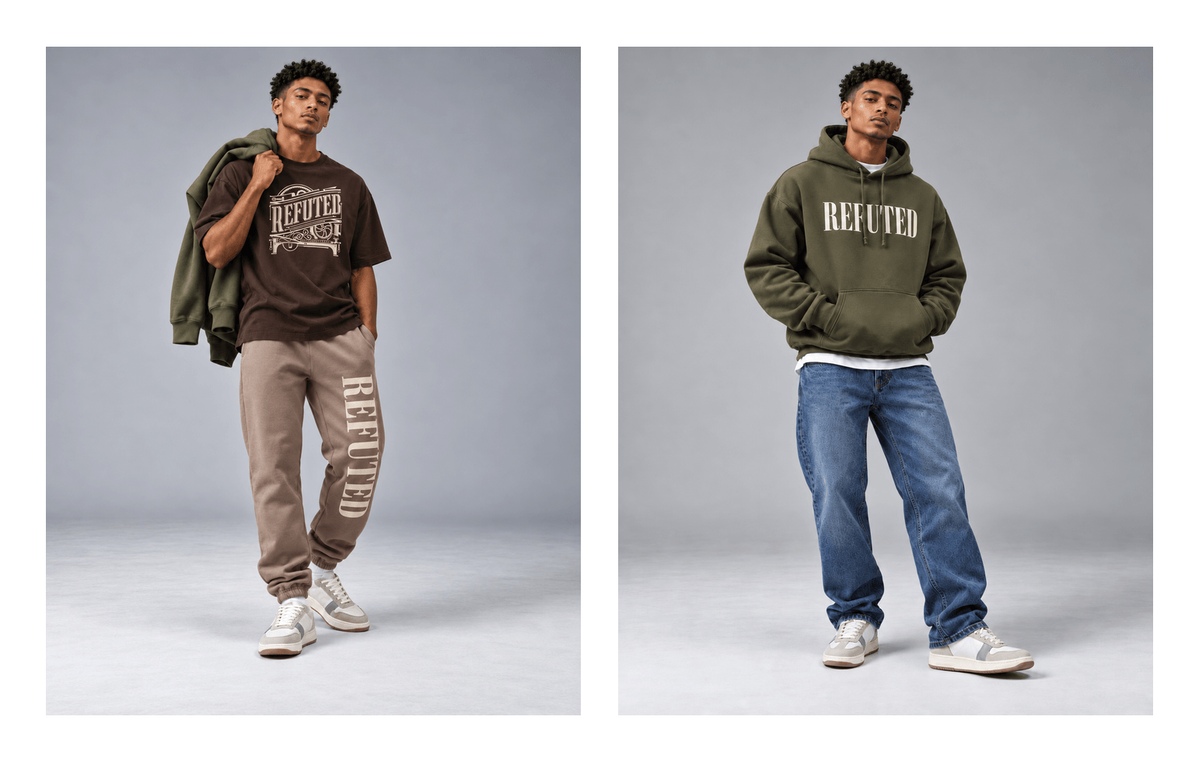
The 75000 on the left and the 19500 on the right, both printed front on a seller's own drop. The drape across the chest, the way the hem sits and the hood holding its shape are the 245 and 360 g/m² doing the work, and none of it is something you can fake with a lighter blank.
What makes Hammer better than a standard Gildan tee?
Three things, and they are worth understanding because they apply to every blank you will ever buy, not just this one.
- Combed ring-spun cotton, not open-end. Combing strips the short fibres out before spinning, and ring-spinning twists what is left into a finer, smoother yarn. Open-end spinning is faster and cheaper and leaves a coarser thread. This is the single biggest reason one cotton tee feels like retail and another feels like a giveaway, and it is why the standard Hammer tee (H000) at 193 g/m² already handles differently to Heavy Cotton at a similar weight.
- A high stitch density. A tighter knit is a flatter print surface, so ink sits on top of the fabric rather than sinking into a loose weave. Fine linework and small type survive. If your artwork carries any detail at all, this is the most important line on the spec sheet and the one most people never read.
- Weight you can feel. Heavy enough to hang properly and to stop a print showing through from the inside. Weight is the first thing a customer notices and the last thing they can argue with.
Gildan Softstyle vs Midweight vs Heavy Cotton: which is heaviest?
The Softstyle Midweight, which catches most people out. If Maxweight is more tee than your range needs, this is where the value sits. Lined up by fabric weight:
- Softstyle ringspun t-shirt (64000): 144 g/m²
- Heavy Cotton t-shirt (5000): 175 g/m²
- Softstyle Midweight t-shirt (65000): 183 g/m²
The tee called Midweight is denser than the tee called Heavy Cotton, and it is 100% ring-spun where Heavy Cotton is not. You get more fabric and a better yarn than the Heavy range, with the hand-feel of the Softstyle range, in the same budget bracket. If you currently default to Heavy Cotton, that is the easiest upgrade in the catalogue.
The same thing happens one layer up. The Heavy Blend sweatshirt (18000) and hoodie (18500) are 257 g/m² of 50/50 cotton and polyester on air-jet yarn, while the Softstyle Midweight sweatshirt (SF000), hoodie (SF500) and full-zip (SF600) are 285 g/m² of 80/20 ring-spun cotton with a 100% cotton face over a brushed interior. The cotton face is the part that shows, because prints land crisper and the garment photographs without the faint sheen a 50/50 blend gives you. The exception is the Midweight pullover hoodie, which carries a real premium over its Heavy Blend equivalent, so if hoodies are a volume line rather than a hero piece then Heavy Blend is still the sensible call.
Is Gildan sustainable?
More than its reputation suggests. Gildan was named to TIME's World's Most Sustainable Companies in both 2025 and 2026, and has appeared on Corporate Knights' Best 50 Corporate Citizens in Canada for five consecutive years as one of only two companies from textiles and clothing manufacturing.
Being on the list is the achievement rather than the position on it, since Gildan sat mid-table in 2025 rather than near the top, but mid-table on a global index is a long way from where the cheap-blanks reputation puts the brand. What sits behind it is structural: Gildan owns its spinning, knitting, dyeing and sewing instead of buying finished garments from third-party factories, so the figures describe its own facilities.
- Biomass energy covering close to 40% of total energy needs
- 2030 targets of 30% lower Scope 1 and 2 emissions against a 2018 baseline and 13.5% on Scope 3 against 2019, aligned with the Science Based Targets initiative
- 20% less water withdrawn from nature by 2030
- Zero manufacturing waste to landfill and 30% recycled polyester or alternative fibre yarns by 2027
For a seller that is the difference between claiming you try and writing a sentence into a product description you can stand behind, and it answers the question that quietly kills club and B2B orders when a procurement contact asks what the ESG position on the garment actually is.
Which Gildan blank should you print on?
- Streetwear, heavyweight drops and big prints: Hammer Maxweight, for the oversized cut and the seamless bodies on the hoodie and sweatshirt.
- Workwear, uniform and premium merch: Hammer H000, for a retail handle and a flat print surface in a classic fit that suits a logo as well as a graphic.
- Best all-round value: Softstyle Midweight 65000, the upgrade to make if Heavy Cotton is your default.
- Lowest cost: Softstyle 64000 on tees, Heavy Blend 18000 and 18500 on hoodies and sweatshirts.
If the real decision is Gildan against a premium organic blank rather than within Gildan, we have an honest comparison with Stanley/Stella. Otherwise weights, fabrics and every available colour are listed per product across the t-shirt range and the hoodies and sweatshirts. Order one of each as a sample before you commit a range to it, because weight is a feel and your hands will settle it faster than any spec table.
First in our Brand Highlight series, covering one brand from our catalogue each week: what it is genuinely good at, what to print on it, and where it is the wrong choice.